Protecting rural properties, livestock, and native wildlife through ethical, targeted and technology‑driven feral pest control solutions.
Across New South Wales, feral pests pose a serious threat to agricultural productivity, animal welfare, biosecurity and the long‑term health of rural landscapes. Invasive species such as feral pigs, foxes, wild dogs, rabbits and deer can cause extensive damage to pasture, fencing, water infrastructure and native ecosystems when left unmanaged. Effective control requires more than short‑term responses — it demands experienced operators, strategic planning and lawful, humane methods.
Our licensed and compliant operators deliver results‑focused feral pest management programs using advanced thermal imaging, GPS mapping and best‑practice field techniques. Every operation is carefully planned to suit the property, species, terrain and seasonal conditions, ensuring control activities are precise, safe and aligned with NSW regulatory and animal welfare standards.
We work closely with landholders across regional and rural NSW, providing practical support to reduce pest pressure, safeguard livestock, restore land condition and strengthen long‑term biosecurity outcomes. Through targeted control and cooperative management, we help protect both productive farmland and the natural environment for the future.
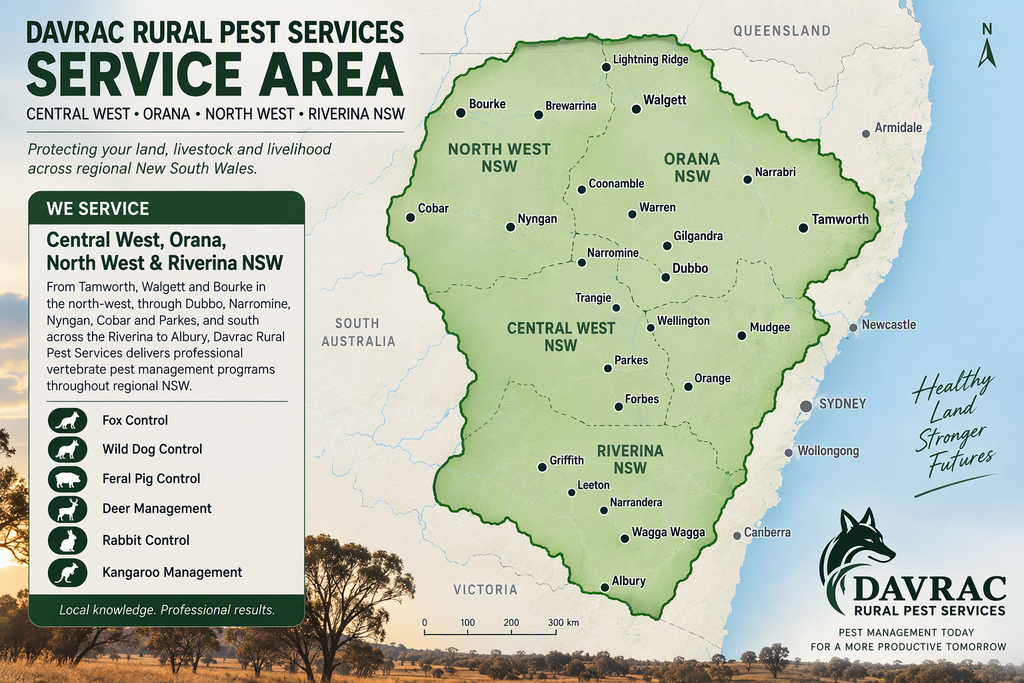
Davrac Rural Pest Services provides structured feral and vertebrate pest management across Central West NSW and surrounding rural regions, supporting landholders, agricultural enterprises, councils, and coordinated control programs.
Our operations are designed for large‑scale, rural environments where pest pressure crosses property boundaries and requires coordinated, long‑term management rather than one‑off intervention.
We regularly operate throughout the Central West, including:
By arrangement, Davrac delivers pest management programs across:
If your property is outside these areas, contact Davrac Rural Pest Services to discuss a coordinated pest management program suited to your location and pest pressure.

Effective pest management delivers more than short‑term control — it creates lasting improvements across the entire property. By combining targeted field strategies, advanced technology, and a property‑specific approach, our programs produce measurable outcomes that support both productivity and long‑term land health.
Our work helps landholders reduce predation, protect livestock, minimize crop and pasture losses, and restore natural balance across their landscapes. Each operation is backed by transparent reporting, clear communication, and a commitment to ethical, compliant practices. The result is a safer, more resilient property with reduced pest pressure and stronger biosecurity outcomes.
Across NSW, our clients see the benefits in improved livestock performance, healthier pastures, reduced infrastructure damage, and greater confidence heading into key production periods. Every job contributes to a more sustainable and productive rural environment — one property at a time.
Professional. Precise. Local.
Davrac delivers compliant, technology‑driven pest management built specifically for rural NSW.
• Licensed, professional operators following NSW Codes of Practice
• Thermal‑driven, targeted control for safe and effective results
• Clear service pathways that make the process simple and predictable
• Neighbour coordination to reduce pest pressure across whole landscapes
• Local knowledge of terrain, species
Location : Gilgandra region
property Type: Cattle Grazing
Issue: Rabbits preventing pasture recovery after drought
Background
Following several dry seasons, a grazing property struggled to recover pasture due to high rabbit and hare numbers. Burrows were expanding, and new pasture shoots were being grazed off before establishing.
Davrac implemented a staged, integrated program:
Burrow mapping and destruction
Targeted night operations
Follow‑up monitoring to prevent recolonization
Advice on pasture management to support recovery
Within 6 months:
Rabbit numbers reduced by 80%+
Pasture cover increased significantly
Soil disturbance decreased
The property regained productive grazing capacity
Davrac didn’t just remove the rabbits — they helped us rebuild the paddocks. The improvement is obvious.
Location : Wellington District
Property Type Sheep Enterprise
Issue: Ongoing predation and lamb losses
Background
A family‑run sheep property was experiencing repeated lambing losses caused by wild dogs and foxes. The landholder had attempted sporadic control efforts, but without coordination across neighbouring properties, predator pressure remained high and unpredictable.
Davrac initiated a coordinated shooting program designed to reduce predator numbers ethically, safely, and in line with NSW legislation and animal welfare standards.
The program included:
Night‑time thermal shooting operations
Pre‑operation monitoring to identify travel routes and hot-spots
Collaboration with neighbouring landholders to reduce re-infestation pressure
A structured schedule aligned with lambing periods
Post‑operation reporting and activity tracking
The emphasis was on precision, compliance, and measurable impact, rather than ad‑hoc or opportunistic control.
Across the participating properties:
Predator sightings dropped significantly within the first month
Lambing survival improved by 25–35%
Landholders reported reduced stress on stock and improved paddock utilization
The group committed to ongoing seasonal coordination to maintain low predator pressure
Davrac’s coordinated approach made a huge difference. The professionalism, communication, and results were far beyond what we’d been able to achieve on our own.
Location: Nyngan NSW
Property Type: Broadacre cropping and Grazing
issue: High Feral Pig numbers causing waterpoint damage, lamb predation and pasture loss
A 7,000‑acre grazing property west of Nyngan had been experiencing steadily increasing feral pig pressure over several seasons. Following a run of favourable rainfall, pig numbers surged, with mobs frequently sighted around dams, creek-lines, and recently regenerated pasture. Damage included:
Heavy rooting around water-points
Predation on newborn calves and lambs
Destruction of newly emerging pasture
Soil disturbance leading to erosion risk
Previous control efforts were inconsistent and lacked a coordinated, property‑wide strategy.
Davrac conducted a full assessment of the property, including:
Mapping of pig movement corridors and high‑pressure zones
Identifying breeding pockets along creek systems
Reviewing neighbouring land use and reinvasion pathways
A tailored feral pig management plan was implemented, combining:
Remote monitoring to track mob size and movement
Targeted night‑time thermal shooting operations
Strategic timing to disrupt breeding cycles
Follow‑up surveillance to measure activity reduction
The focus was on precision, compliance, and long‑term suppression, rather than short‑term removal.
Within the first 8 weeks:
Feral pig activity reduced by an estimated 65–75%
Damage around dams and creek-lines dropped significantly
Pasture recovery improved due to reduced rooting pressure
lambing losses stabilized
The landholder has since committed to a seasonal monitoring and control program to maintain low pig numbers and prevent re-infestation.
Davrac brought structure and strategy to a problem we’d been chasing for years. The difference in pig pressure and paddock condition is obvious